
The biggest risk of the AI revolution may not be that machines become smarter than humans. It may be that humans gradually become dependent on systems they no longer control.
Something unusual is happening in the technology world.
Over a relatively short period, several major organizations responsible for running essential parts of modern civilization have experienced service disruptions. Microsoft, the Federal Aviation Administration (FAA), Anthropic, JPMorgan Chase, and Apple have all appeared in recent outage reports. Binance has also experienced a major security incident recently.
Individually, these events have different explanations. Some involve software bugs, others infrastructure problems, and at least one involves a serious security breach.
But there is a bigger question worth investigating.
As artificial intelligence becomes increasingly integrated into banking, aviation, communication, commerce, government, and everyday business operations, are we witnessing a fundamental restructuring of the world's technological infrastructure?
Perhaps the most important development isn't that individual companies are experiencing outages. It is that the world is becoming increasingly dependent on a relatively small number of technology providers, cloud platforms, AI models, and interconnected systems.
And that raises a question that deserves far more attention:
What happens when the systems that run our world are no longer truly ours?
1. The incidents: A timeline worth examining
Before drawing conclusions, it is important to establish what actually happened. The following timeline separates confirmed outages from security incidents and user-reported disruptions.
The incidents are not all the same, and their causes should not be confused.
Chronological timeline: October 29 – November 17, 2026
|
Date |
Organization |
Reported incident |
|---|---|---|
|
October 21–22, 2026 |
PHP |
Critical PHP vulnerabilities prompted precautionary shutdowns of government, hospital, school, and other websites across multiple countries while security updates were applied. |
|
October 29 |
Binance |
Major security breach involving unauthorized withdrawals |
|
November 8 |
Anthropic |
Degraded performance affecting Claude services |
|
November 12–13 |
Microsoft |
Major Microsoft 365, Outlook, Teams and Copilot disruption |
|
November 13 |
Anthropic |
Authentication problems and elevated errors across Claude services |
|
November 13 |
FAA |
Nationwide ground stop following telecommunications and router-related problems |
|
November 16 |
JPMorgan Chase |
Online banking and transaction delays |
|
November 17 |
Apple |
Disruptions affecting Apple services, including account sign-in and subscription purchases |
The dates above refer to the incidents, not necessarily the dates on which companies published their explanations.
Let's examine them individually.
October 21–22, 2026: PHP Security Crisis Triggers Global Website Shutdowns
A critical security vulnerability in PHP, one of the most widely used programming languages on the internet, triggered emergency responses across multiple countries. Governments, companies, financial institutions, airlines, hospitals, and other organizations temporarily shut down websites and online services to protect their systems while security patches were being implemented.
The vulnerability reportedly exposed systems to potential attacks that could compromise servers, files, and databases. Cybersecurity agencies urged organizations to update their systems immediately or take vulnerable services offline until they could be secured.
The incident was particularly noteworthy because AI-assisted research reportedly played a role in identifying the vulnerabilities. It highlighted both sides of the AI revolution: artificial intelligence could help discover dangerous security flaws, but it could also accelerate the discovery of vulnerabilities that threaten the infrastructure upon which the world depends.
This was not evidence of a coordinated global shutdown. Rather, it demonstrated how a single vulnerability in widely used software could cause disruptions across countries and industries simultaneously.
October 29: Binance – A major security incident
Binance experienced a serious security incident on October 29, 2026.
According to its October 30 announcement, unauthorized withdrawals occurred at approximately 20:05 UTC, after its hot wallets were compromised. The estimated value of the affected digital assets was approximately $6.3 billion.
The FBI subsequently attributed the theft to North Korean actors, identifying the activity as TraderTraitor.
Binance temporarily suspended withdrawals while conducting security checks and took steps to contain the compromised infrastructure. Its November 3 update reported that approximately $2.85 billion in assets had been frozen or intercepted. Binance Support
This is an important incident, but it should not be presented as an unexplained technology shutdown. There is an identified security investigation and a publicly stated attribution.
November 8: Anthropic – Claude experiences degraded performance
Anthropic reported an incident affecting Claude Fable 5.1.
According to its status history, the impact occurred from 08:18 UTC to 08:32 UTC on November 8, affecting Claude services.
Although relatively short, it demonstrates that even advanced AI platforms can experience service interruptions. anthropic.statuspage.io
November 12–13: Microsoft – A major global disruption
One of the most significant incidents in this sequence involved Microsoft.
Beginning on November 12, users experienced widespread problems accessing Outlook, Exchange Online, Microsoft 365, Teams, Copilot, and other services.
The preliminary incident report identified the following period:
-
Start: November 12, 16:20 UTC.
-
End: November 13, 16:10 UTC.
-
Duration: Approximately 23 hours and 50 minutes.
The disruption affected users across multiple regions and interrupted business operations, email communication, and other services.
Microsoft's investigation identified a combination of problems involving network maintenance and upgrades, a latent software bug, unavailable servers, and overloaded infrastructure.
The company reported that traffic shifts during network changes exposed a defect that caused requests to accumulate until affected servers could no longer accept new connections.
Microsoft also stated that there was no indication of malicious or cyber activity.
This incident deserves particular attention because it demonstrates how a relatively small number of infrastructure problems can affect a vast collection of interconnected services.
November 13: Anthropic – Another disruption
Anthropic experienced two separate incidents on November 13.
The first affected authentication for Claude.ai and Claude Code:
-
Start: 09:58 UTC.
-
Resolved: 11:58 UTC.
The second involved elevated errors affecting Claude.ai, the Claude API, Claude Code, and additional services.
-
Start: 13:09 UTC.
-
Resolved: 15:38 UTC.
The second incident lasted approximately two hours and 29 minutes.
Anthropic's public status updates documented the investigation, mitigation, and recovery. Is Anthropic down? Live status and incident history
November 13: FAA – Nationwide aviation disruption
On November 13, the Federal Aviation Administration experienced a technical problem that resulted in a nationwide ground stop.
According to the FAA:
-
Start: Approximately 3:30 p.m. Eastern Time (19:30 UTC).
-
Air traffic resumed: 8:15 p.m. Eastern Time (November 14, 01:15 UTC).
The FAA explained that legacy equipment became unstable after data flooded its telecommunications network at approximately 1,000 connection attempts every four to five seconds.
The problem was associated with a routine router replacement at a remote facility. The FAA subsequently disabled the originating router functionality and took precautionary action on more than 60 similar routers.
The FAA reported approximately 12,462 flight cancellations following the incident, although it clarified that not all cancellations were directly caused by the ground stop.
This was a serious disruption, but the FAA has provided a specific technical explanation. Federal Aviation Administration
November 16: JPMorgan Chase – Banking disruption
On November 16, thousands of customers reported problems accessing Chase online banking services.
Customers experienced login difficulties and transaction delays. Some transactions involving other banks were also affected.
According to reporting by the Associated Press, Chase attributed the problem to a software bug in its internal hardware systems.
The bank said customers retained access to their funds, although some transactions were delayed. Chase described the problem as an isolated technical issue rather than a cyberattack.
Other financial institutions experienced increased customer complaints, but this does not establish that their own systems had failed. apnews.com
November 17: Apple – Multiple services experience problems
The latest incident in this sequence involves Apple.
On November 17, users reported problems accessing several Apple services, including:
-
iCloud
-
App Store
-
Apple Pay
-
Apple Support
-
Apple Account sign-in
-
App Store Connect
Reports included authentication failures, unexpected sign-outs, and problems downloading applications.
Apple's status information showed problems affecting account sign-in and subscription purchases, although the broader scope of user reports was not always reflected in its official status page.
One officially tracked subscription-purchase incident began at approximately 08:47 UTC and was marked resolved at approximately 12:02 UTC.
A separate account sign-in issue was also reported later in the day. The broader disruption's exact start and end times have not been independently established. 9to5Mac
2. What do these incidents have in common?
At first glance, these organizations have very little in common.
One operates a global software ecosystem. Another manages cryptocurrency exchange services. One is responsible for aviation safety. Another operates one of the world's largest banking businesses. Anthropic develops AI models, while Apple provides devices, software, and digital services.
Their immediate technical problems are also different.
But there is one important similarity.
They are all part of an increasingly interconnected technological civilization.
Modern organizations rarely operate entirely independently anymore.
A bank may have its own applications, databases, employees, and security systems. But it may depend on external cloud infrastructure, networking providers, identity systems, software vendors, and payment networks.
An airline may have its own operational infrastructure, but it depends on telecommunications, navigation, data exchange, and aviation technology.
A technology company may develop its own AI model but depend on external computing resources, specialized chips, data centers, and electricity infrastructure.
This means that the visible organization is not necessarily the same as the infrastructure underneath it.
The more interconnected these systems become, the more difficult it becomes to determine where one organization's technological boundaries actually end.
And this is where the larger story begins.
3. The invisible infrastructure connecting the world
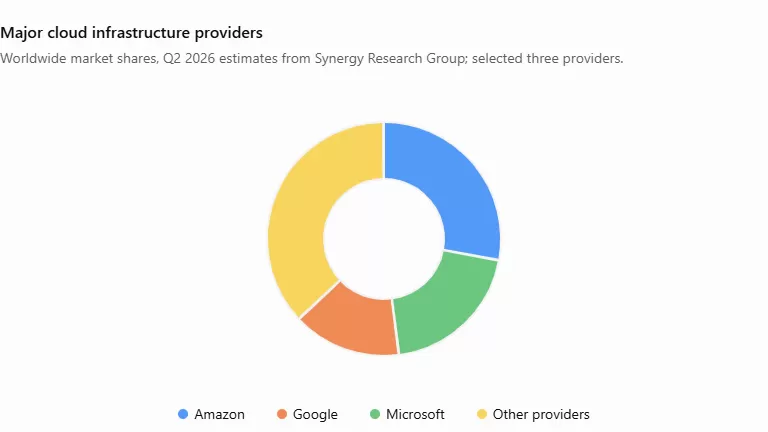
Consider the three major cloud infrastructure providers: Amazon Web Services, Microsoft Azure, and Google Cloud.
According to Synergy Research Group's second-quarter 2026 estimates, their respective worldwide cloud infrastructure market shares were approximately:
-
Amazon: 28%.
-
Microsoft: 20%.
-
Google: 15%.
Together, they represented approximately 63% of the market measured by that research. Synergy Research Group
These numbers do not mean that these companies control every digital service. Nor does a cloud provider necessarily have access to all the information stored by its customers.
But they illustrate something significant: a substantial portion of the world's cloud computing infrastructure is concentrated among a small number of providers.
The OECD has also identified high concentration, switching costs, infrastructure barriers, and the importance of hyperscale providers as competition concerns in cloud markets. one.oecd.org
Now consider what happens when AI becomes another essential layer on top of this infrastructure.
A business might use one company's cloud services, another company's AI model, a third company's payment gateway, and an external identity provider.
All these services may appear independent to the end user.
But their technological dependencies can overlap.
If a shared provider experiences a significant failure, the consequences may spread across many businesses that otherwise have no direct relationship with one another.
This is the hidden risk of centralization.
It does not require a secret agreement, coordinated shutdown, or malicious intention.
It can happen simply because the world increasingly relies on the same foundations.
4. The AI transition: Something much bigger than chatbots
For years, artificial intelligence was largely viewed as an experimental technology.
People used it to generate images, write content, answer questions, and automate relatively simple tasks.
That period is changing rapidly.
AI is moving from being a tool that people open occasionally to becoming an infrastructure layer that businesses can integrate directly into their operations.
Consider what is happening across the industry:
-
AI agents are being developed to execute tasks rather than simply answer questions.
-
Software companies are integrating AI into their core products.
-
Businesses are experimenting with autonomous customer support and administration.
-
Developers are using AI to write, review, and maintain software.
-
Financial institutions are adopting AI for fraud detection, risk analysis, and operational automation.
-
Governments are exploring AI for public services and information processing.
-
Data center operators are investing enormous amounts of money in computing infrastructure.
This is not speculation. It is a documented industry-wide transformation.
The Stanford Institute for Human-Centered AI's 2026 AI Index reports that industry produced more than 90% of notable AI models in 2025. It also reports that organizational AI adoption reached 88%. Stanford HAI
The financial scale is equally remarkable.
According to the same research, global corporate AI investment more than doubled in 2025, reaching approximately $581.69 billion when including private investment, mergers, and acquisitions. Generative AI investment grew particularly rapidly. Stanford HAI
The industry is not simply building smarter software.
It is building the infrastructure required to operate an increasingly AI-dependent economy.
And that infrastructure requires enormous amounts of computing power, specialized chips, electricity, networking, and capital.
The question is no longer whether AI will become part of our infrastructure.
It is how deeply it will become embedded in the systems that civilization depends on.
5. From independent systems to centralized technological dependency
Imagine a business owner in 2030.
The business uses an AI agent to manage customer communications, process orders, prepare invoices, monitor payments, analyze sales, and coordinate employees.
The owner may not need to interact with five different software applications anymore.
One AI assistant could become the primary interface for almost everything.
Now imagine the same transformation taking place across millions of businesses.
Banks, hospitals, airlines, government departments, educational institutions, retailers, and technology companies begin relying on AI agents to coordinate increasingly complex operations.
The traditional software interface gradually becomes less important.
Instead of employees navigating different applications, they give instructions to an AI system that communicates with those applications on their behalf.
This is a fundamental change in how technology operates.
But it introduces an important question:
Who controls the infrastructure behind that AI assistant?
The business may own its customer database, but it might not own the AI model.
It may own its software, but not the cloud infrastructure on which it operates.
It may control its employees and business decisions, but increasingly rely on an external AI provider to execute its daily operations.
In other words, ownership of a business does not necessarily mean ownership of all the technology required to run it.
This distinction could become increasingly important as AI agents become more capable.
The invisible transfer of dependency
A transition does not necessarily need to happen through a dramatic announcement.
It can happen gradually:
-
A company adopts AI to improve efficiency.
-
More business processes become dependent on that AI.
-
Employees begin relying on automated decisions and recommendations.
-
Traditional processes are reduced or eliminated.
-
The company becomes increasingly dependent on the AI provider.
-
Switching to another provider becomes expensive and difficult.
Eventually, the company may discover that its operational independence has diminished.
This is not necessarily an intentional transfer of ownership or control.
It is a possible consequence of technological dependency.
And it is one of the most important risks that businesses and governments should be examining today.
6. Who controls the infrastructure behind artificial intelligence?
There is a common misunderstanding about AI.
People often imagine that an AI model is simply a piece of software running somewhere on the internet.
In reality, advanced AI systems depend on an enormous technological ecosystem.
That ecosystem includes:
-
Semiconductor manufacturers.
-
Specialized AI processors.
-
Data centers.
-
Cloud computing providers.
-
Electricity generation and transmission.
-
Networking infrastructure.
-
Data storage systems.
-
Model developers.
-
Software platforms.
-
Telecommunications networks.
Control over these individual components can translate into considerable economic and strategic influence.
The 2026 Stanford AI Index highlights another important concentration risk: almost all leading AI computing hardware relies on chips manufactured by a single major Taiwanese foundry, TSMC. hai.stanford.edu
This creates another layer of dependency.
Even if dozens of AI companies compete with one another, they may rely on overlapping hardware supply chains and infrastructure providers.
The OECD's research on AI markets also identifies concentrated cloud infrastructure, specialized hardware, high investment requirements, and switching costs as potential competition risks. OECD
Think about the implications.
If a small number of companies provide a large proportion of the computing resources needed by the AI industry, their influence extends far beyond their own products.
They become important infrastructure providers for other businesses, including companies that may technically compete with them.
The same applies to advanced chips, energy infrastructure, and data centers.
This is where technological power becomes more complicated than simply owning a popular AI application.
The company controlling the application may not control the underlying infrastructure.
The company controlling the infrastructure may not own the application.
But both may hold critical positions in the same technological ecosystem.
And that ecosystem is becoming increasingly important to the global economy.
7. Are we approaching a new form of centralized control?
Let's consider a possible future.
A person wakes up and asks an AI assistant to organize their day.
The assistant checks their calendar, communicates with their employer, processes payments, books transportation, manages subscriptions, and organizes personal tasks.
At work, another AI system manages the company's orders, customer relationships, accounting, inventory, and reporting.
A financial institution uses AI to monitor transactions and assess risk.
An airline uses automated systems to coordinate scheduling and operational decisions.
A government uses AI to process applications, manage information, and deliver services.
Individually, each integration may make life easier.
But collectively, they could create a world in which a relatively small number of technological platforms sit between people and the systems they depend on.
This is where the question of control becomes unavoidable.
Who determines which services the AI can access?
Who decides what information it can process?
Who sets its operational boundaries?
Who can change its permissions?
Who can suspend access?
And who is accountable when an automated system makes a decision that affects millions of people?
These are not imaginary questions.
They are governance and competition questions already being raised as AI becomes integrated into important economic sectors.
There is also a distinction between control over an AI model and control through an AI model.
A company does not necessarily need to own every business it serves to influence how those businesses operate.
If thousands of organizations depend on its infrastructure, software, and AI services, its decisions about pricing, availability, permissions, and product changes can have far-reaching consequences.
That influence deserves public scrutiny.
8. Are the recent outages connected?
This is where we must be particularly careful.
It would be easy to look at the timeline and conclude that the events must be connected.
But chronological proximity is not evidence of coordination.
In fact, the available explanations show important differences.
-
Microsoft reported a software and infrastructure problem associated with network changes and unavailable servers.
-
The FAA identified a telecommunications and router-related failure.
-
Chase reported a software bug affecting its internal systems.
-
Anthropic reported service and authentication errors.
-
Binance reported a security breach attributed by the FBI to North Korean actors.
-
Apple experienced problems involving several services, with the full scope and cause of the broader user-reported disruption not established.
There is no verified evidence that these incidents were coordinated or that they were deliberately initiated as part of an AI transition.
There is, however, an interesting detail worth examining.
During November 12, Anthropic reported elevated errors affecting its Microsoft 365 connector and identified an upstream provider issue. This was occurring during Microsoft's wider disruption. That provides evidence of a dependency affecting one particular integration, not evidence that the other incidents shared a common cause.
This distinction matters.
The more technology becomes interconnected, the more likely it is that an incident in one system will affect another.
And this may be the more important story.
Three possible explanations
Scenario A: Independent incidents
The organizations experienced unrelated problems.
This explanation is supported by the specific causes reported by Microsoft, the FAA, Chase, and the FBI's findings concerning Binance.
Scenario B: Shared infrastructure vulnerabilities
The incidents are unrelated in their immediate causes, but collectively illustrate the fragility of a highly interconnected digital economy.
A software bug, a router failure, or an unavailable cloud service can have consequences far beyond the organization in which the problem originates.
Scenario C: A wider AI and infrastructure transition
The world is undergoing a major transition toward AI-powered infrastructure and centralized computing.
The outages may have occurred during this broader period of transformation, but there is currently insufficient evidence to conclude that the incidents were caused by AI migration or coordinated infrastructure replacement.
Of these possibilities, the second and third deserve particularly serious long-term attention.
Not because they establish a hidden plan, but because they raise legitimate questions about the direction in which global technology is moving.
9. The dangerous side of technological convenience
There is something particularly interesting about how humanity adopts technology.
We usually adopt something because it makes life easier.
Email replaced much of traditional correspondence. Online banking reduced the need to visit branches. Smartphones replaced dozens of individual devices. Cloud computing made it possible for businesses to operate without owning enormous server rooms.
AI is following the same pattern, but potentially at a much greater scale.
The difference is that previous technologies generally helped people perform specific tasks.
Advanced AI systems are increasingly being developed to perform entire workflows.
They can interpret information, make recommendations, use software, communicate with other systems, and execute actions.
The more capable these systems become, the more attractive it becomes to hand over additional responsibilities.
But convenience has a cost that is easy to overlook: dependency.
What if access is restricted?
Imagine a world where a business depends on an external AI platform to manage its operations.
What happens if the provider suddenly suspends access?
What happens if the subscription price increases dramatically?
What happens if the model changes its policies?
What happens if a government restricts access to a particular platform?
What happens if the provider experiences a prolonged outage?
The business may technically own its assets, employees, and customers, but it could struggle to operate without the infrastructure it has become dependent on.
The same concern applies to public institutions.
If essential government services become dependent on privately operated AI infrastructure, governments will need to ensure they retain sufficient control, oversight, and alternatives.
This is not an argument against AI.
It is an argument against allowing convenience to eliminate technological independence.
The concentration of information
There is another risk.
AI assistants may increasingly become the primary interface through which people access information.
Instead of visiting dozens of websites, reading multiple publications, or comparing different sources, people may simply ask one AI system for an answer.
That system decides what information to retrieve, how to summarize it, and what to present.
This can be incredibly useful.
But it also raises questions about information diversity, transparency, bias, and the influence of whoever operates the underlying platform.
If a small number of AI systems become the primary gateway to information, their design decisions could influence how millions of people understand the world.
The concern is not that every AI company intends to manipulate people.
The concern is that enormous influence can emerge from infrastructure concentration even without malicious intentions.
Could a single failure create a global problem?
Consider the consequences of a major disruption affecting a widely used cloud or AI provider.
Businesses might lose access to critical applications.
Financial institutions might experience processing delays.
Customer service operations could stop functioning.
Automated workflows might become stuck.
Government services could be interrupted.
The impact would depend on the architecture of each organization, its backup systems, and the particular services affected.
But the broader risk is clear: the more interconnected the infrastructure, the greater the potential for cascading disruptions.
This is why technological resilience must become as important as technological innovation.
10. What could happen in the coming days, months, and years?
Nobody can accurately predict the exact direction of the AI revolution.
However, the developments already taking place allow us to consider several plausible scenarios.
The coming months: Faster integration
We are likely to see further integration of AI into existing software platforms.
Companies will continue experimenting with AI agents that can execute tasks, manage workflows, and communicate with external services.
Businesses will increasingly evaluate how much of their operational workload can be automated.
Cloud infrastructure and data center investments will remain central to this expansion.
The biggest challenge will be ensuring that these integrations do not introduce new vulnerabilities or create excessive dependence on a single provider.
The coming years: AI becomes an operational layer
A more significant change could occur over the next several years.
Instead of using separate applications for individual tasks, people may increasingly interact with AI systems that coordinate multiple services.
An AI agent might manage an entire business workflow, from receiving an order to processing payment and coordinating delivery.
Financial institutions may use AI for increasingly sophisticated operational processes.
Governments may integrate AI into public administration.
The distinction between traditional software and AI-driven systems may gradually become less visible.
At this stage, the companies providing the underlying infrastructure could gain even greater strategic importance.
The long-term future: Who operates civilization?
This is the most important question.
Could AI eventually become the operational layer of modern civilization?
Imagine a world where much of the global economy depends on interconnected AI systems.
Transportation, communication, financial processing, business operations, logistics, education, and public services could all rely on AI-driven infrastructure.
Such a future could deliver enormous improvements in productivity, accessibility, and economic growth.
But it could also create an unprecedented concentration of technological power.
The organizations controlling the most important AI models, computing infrastructure, and digital platforms could become extremely influential.
Governments might find themselves regulating systems on which their own institutions depend.
Businesses might find it difficult to leave platforms that have become deeply integrated into their operations.
Individuals might discover that everyday activities are increasingly mediated by systems they neither own nor understand.
This is not a prediction that one company or AI model will control the entire planet.
It is a warning about the possibility of structural dependence becoming so extensive that meaningful alternatives become increasingly difficult to maintain.
11. What should humanity be concerned about?
There is a tendency to discuss AI safety primarily in terms of whether machines will become more intelligent than humans.
That is an important discussion.
But another question deserves equal attention:
Will humans retain meaningful control over the infrastructure that AI systems operate?
A responsible AI future should include several essential safeguards.
1. Independent infrastructure
Critical institutions should maintain the ability to operate independently when external AI or cloud services become unavailable.
2. Multiple providers
Businesses and governments should avoid unnecessary dependence on a single cloud provider, AI model, or technology platform.
3. Human oversight
Important financial, medical, aviation, and government decisions should have appropriate human supervision and accountability.
4. Data ownership
Organizations and individuals should retain meaningful rights over their data and understand how external AI platforms process it.
5. Transparent governance
AI providers should be accountable for important operational decisions, security practices, and changes that affect their customers.
6. Strong disaster recovery
Essential systems should have tested backup infrastructure, recovery procedures, and alternative operating arrangements.
7. Government independence
Governments should ensure that critical public services do not become completely dependent on infrastructure that they cannot adequately oversee or replace.
Technological progress should increase human capabilities, not gradually remove human control.
12. The real question is not whether AI will take over
Perhaps we are asking the wrong question.
For years, discussions about artificial intelligence have focused on whether AI will eventually become smarter than humans.
But what if the more immediate transformation is happening somewhere else?
What if AI does not need to become smarter than every human to become essential to almost everything humans do?
Consider the difference.
A person may still make their own decisions, but depend on an AI system to obtain the information needed to make those decisions.
A business owner may still own their business, but depend on external AI platforms to operate it.
A government may still have political authority, but depend on privately operated technological infrastructure to deliver essential services.
A bank may still control its financial operations, but depend on external technology providers to process and secure them.
In all these situations, formal ownership and practical independence are not necessarily the same thing.
And that may be one of the defining challenges of the AI era.
13. Conclusion: What happens when the systems that run our world are no longer truly ours?
The outages of recent days should not be treated as proof of a secret global transition.
The available evidence does not establish that Microsoft, Binance, the FAA, Chase, Anthropic, and Apple are coordinating their operations, deliberately shutting down their systems, or handing control to one central AI model.
The PHP security incident of October 21–22 provides another example of the vulnerabilities inherent in our interconnected digital infrastructure. The discovery of critical vulnerabilities in a widely used programming language led organizations across multiple countries to temporarily take websites and services offline while security updates were deployed. Although this incident was unrelated to the outages discussed above, it demonstrates how a single vulnerability in foundational technology can have widespread consequences. As the world becomes increasingly dependent on interconnected digital systems and AI-powered infrastructure, the resilience and security of these technologies become critical questions for the future.
Their reported incidents have different explanations, and some remain incompletely understood.
But dismissing the bigger questions simply because the individual incidents have technical explanations would also be a mistake.
Something significant is happening in the technology industry.
AI is becoming more capable. Companies are investing unprecedented amounts of money in computing infrastructure. Cloud platforms are becoming increasingly important. Businesses are experimenting with autonomous agents. Governments are exploring AI integration. And an increasingly large portion of the global economy is being built on interconnected digital systems.
These are real developments.
The danger may not be a dramatic moment when someone switches off the old world and switches on a new one.
It may be a gradual transition that happens so naturally that most people barely notice it.
One company adopts an AI platform.
Another automates its operations.
A government integrates an external model.
A bank becomes dependent on a new infrastructure provider.
A business removes traditional processes because AI appears faster and cheaper.
One dependency leads to another.
Eventually, the world may reach a point where entire industries cannot function normally without access to a relatively small number of technological platforms.
And then the question of control becomes much more serious.
Who controls these systems?
Who determines how they operate?
Who has the authority to restrict access?
Who decides what happens when the infrastructure fails?
And perhaps most importantly, what happens if humanity becomes so dependent on these systems that it can no longer operate independently?
We should welcome innovation. We should embrace the opportunities AI offers. We should allow technology to improve productivity, healthcare, education, communication, and everyday life.
But we must also recognize that technological independence is a form of power.
A civilization that cannot operate without infrastructure controlled by a handful of organizations may eventually find itself with fewer choices than it realizes.
The biggest risk of the AI revolution may not be that machines become smarter than humans.
It may be that humans gradually become dependent on systems they no longer control.
Perhaps the most important question of our generation is not what artificial intelligence will become, but what humanity will become when almost everything depends on it.
And that is a question we should start asking before the transition is complete.
Sources and further reading
The following sources support the incident timeline and the wider technology analysis.
Frequently asked questions
1. Are recent global technology outages connected to artificial intelligence?
There is currently no verified evidence connecting all the recent outages to AI. However, they highlight the importance of understanding the infrastructure dependencies that support modern technology.
2. Why is the world becoming dependent on a few cloud providers?
Large cloud providers offer extensive infrastructure, global availability, specialized services, and economies of scale. These advantages make them attractive, but can also create switching costs and concentration risks.
3. Could AI eventually control critical global infrastructure?
AI could increasingly manage or assist with critical operations. However, the extent of its authority will depend on human decisions, regulation, technical safeguards, and institutional oversight.
4. What happens if a major AI or cloud provider experiences an outage?
Businesses and institutions depending on that provider could experience service interruptions. The consequences would depend on their backup systems, alternative providers, and disaster recovery arrangements.
5. Is centralized AI infrastructure dangerous for humanity?
It can create risks involving technological concentration, privacy, accountability, economic power, and operational dependency. Strong governance and independent infrastructure can help reduce those risks.
Discussions (0)
No comments yet. Start the discussion below!
Leave a Reply